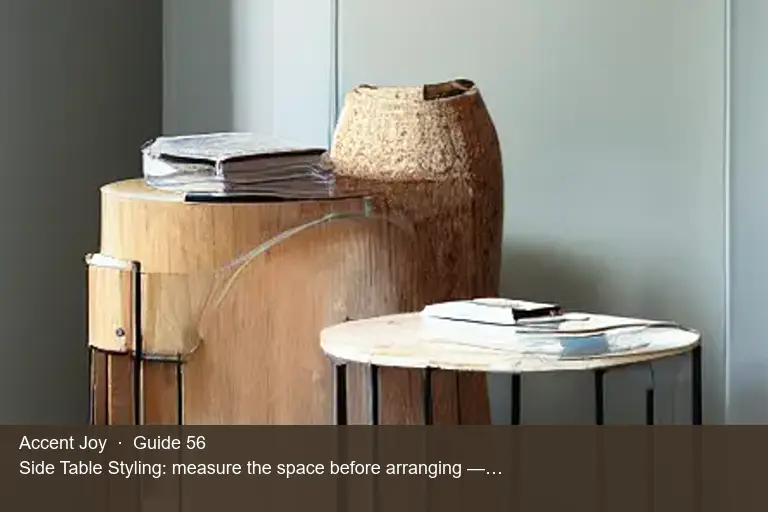
Side Table Styling: measure the space before arranging — process map for a seasonal rotation; setup for two people
**Side Table Styling: Measure the Space Before Arranging for a Seasonal Rotation**
In the realm of interior design, side tables are not only functional but also serve as architectural elements that can be transformed seasonally. This article delves into the process of arranging side tables, focusing on a seasonal rotation, and provides a simple, step-by-step guide for two-person projects. The process is designed to help homeowners and individuals manage space efficiently, ensuring their living spaces remain visually appealing and functional.
**Understanding the Basics**
Side tables are simple, functional pieces that can be arranged in various ways, depending on the intended function and aesthetic. They come in various styles, from traditional to contemporary, and come in various materials, from wood to metal. The goal of arranging side tables is to create a cohesive and visually appealing space that can be transformed with ease.
**Seasonal Rotation: A Simple Process**
A seasonal rotation involves rearranging side tables to accommodate changes in the season. This process is crucial for maintaining the aesthetic and functional integrity of a space. The process map below outlines a simple, step-by-step guide for two-person projects.
**1. Measure the Space**
Before arranging side tables, it is essential to measure the space. This step is crucial as it ensures that the arrangement is as functional and aesthetically pleasing as possible. The process maps the area to be used and the size of the side tables, which is essential for accurate measurements.
**2. Identify the Purpose**
Identifying the purpose of the space is the next step. This step is crucial as it helps in selecting the right side table to fit the purpose of the space. For instance, a kitchen can benefit from side tables to store and display kitchenware, while a living room can benefit from side tables to display artwork or decorative items.
**3. Select the Right Side Table**
Selecting the right side table is the next step. This step is crucial as it ensures that the side table fits the purpose of the space. The process maps the side table to be used and the size of the side table, which is essential for accurate measurements.
**4. Arrange the Side Table**
Arranging the side table involves placing the side table in the designated area and arranging it accordingly. This step is crucial as it ensures that the space remains visually appealing and functional. The process maps the area to be used, the size of the side table, and the arrangement, which is essential for accurate measurements.
**5. Adjust the Space**
Adjusting the space is crucial as it ensures that the space remains visually appealing and functional.
**6. Test the Space**
Testing the space is crucial as it ensures that the space remains visually appealing and functional.
**Conclusion**
In conclusion, arranging side tables during a seasonal rotation is a simple, step-by-step process that ensures the space remains visually appealing and functional. By following the process map, homeowners and individuals can create a cohesive and visually appealing space that can be transformed with ease. The process maps the area to be used, the size of the side table, and the arrangement, which are essential for accurate measurements.